
Thanks so much for stopping by! I hope you'll engage by leaving comments, be encouraged, occasionally chuckle at discovered quirkiness, and even be inspired in faith. Please use the button to subscribe via email so you won't miss a post!
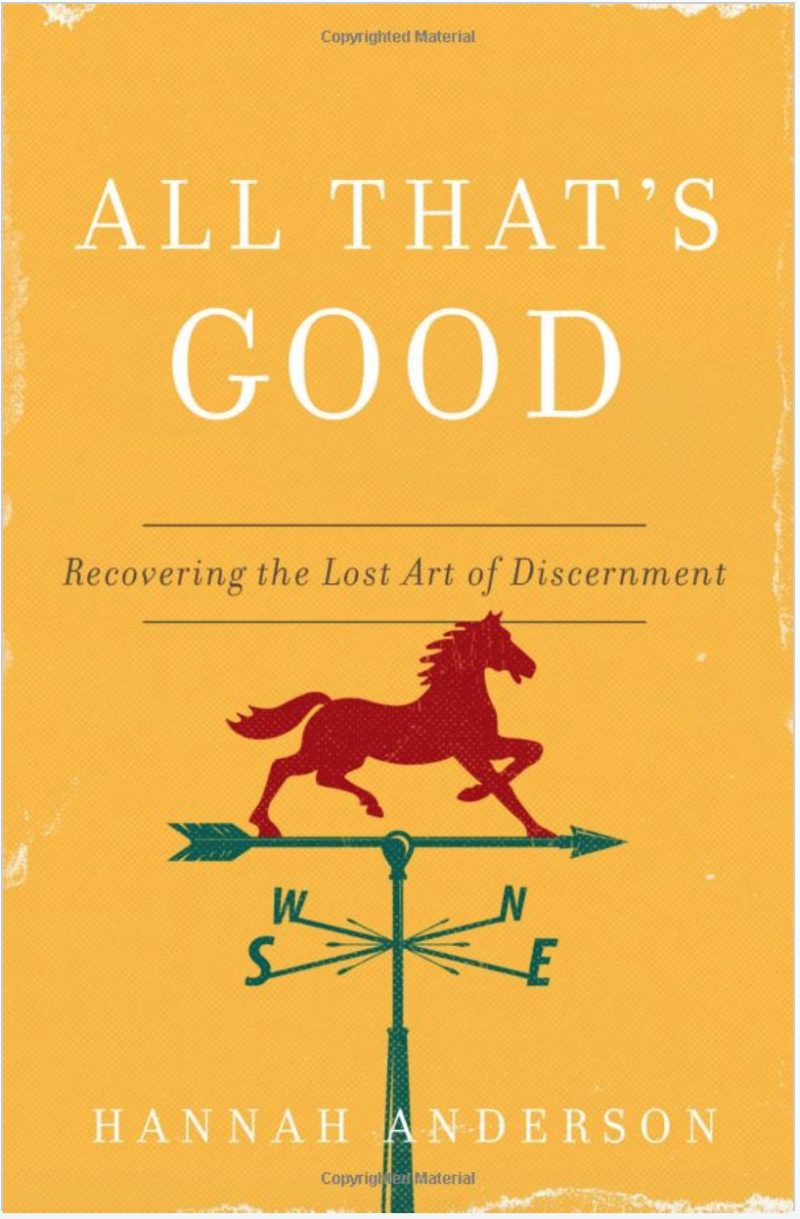
Review: All Things Good
Hannah Anderson's book on discernment is worth reading, and as we seek "all that's good," we are urged to not just identify the good, but to practice it.

 I really enjoyed Hannah Anderson’s book Humble Roots [reviewed here] and I was eager to read All That’s Good. The subtitle is “Recovering the Lost Art of Discernment.” I read Tim Challies’ The Discipline of Spiritual Discernment[review here] and hoped this book would be another welcome addition to a subject the American church needs so much more application of.
I love how she emphasizes that discernment is not primarily to identify what is bad or unworthy. Rather, biblical discernment directs us to identify what is good. With that principle firmly rooted, she turns to Philippians 4:8-9 and Paul’s instructions to “think on these things” as she unpacks each element of spiritual thinking:
- Whatever is true
- Whatever is honorable
- Whatever is just
- Whatever is pure
- Whatever is lovely
- Whatever is commendable
I was not disappointed. Her introductory chapters (1-3) were fantastic. I did think the book bogged down a bit in the middle. However, there are great nuggets throughout. Her chapter on “what is commendable” is truly remarkable (worth talking about) and has powerful application to our modern information-overloaded culture, especially as we relate to social media.
“Whatever is commendable, it is calling us to something greater than niceness – it’s calling us to speak what is right and good. It is calling us to speech that is richer and more robust than either platitudes or silence. Remember that discernment is not concerned primarily with our social comfort. It is concerned with goodness. And sometimes pursuing goodness will lead us outside the boundaries of polite conversation.”
Paul’s word to the Philippians in verse 9 is direct. “Do what you have learned and received and heard from me, and seen in me..” Anderson points out that discernment is not just for us to think about certain things but to begin to practice those things. We look for models and mentors and we associate ourselves with a community of faith that will nurture these qualities as good.
It is not enough to sound off about the negative, the detrimental and the bad. What the church and culture need are people who will speak graciously about what is good. People who identify the good, promote the good, work for the good and reveal the good.
I find it profoundly interesting that when Jesus was called “good teacher” by the rich young ruler in Luke, He deflected with a question, “Why do you call me good?No one is good except God alone.” (Luke 18.19) It was because the rich young ruler brought Him flattery in his compliment. He didn’t know that he was speaking the truth to the man who is Truth Incarnate.
As we seek to identify “all that’s good,” it will inevitably lead us to the author of all that’s good – Jesus. May His good captivate our hearts and minds and lead us away from what is not good.
I highly recommend this book.


Sounds like a very good book on discernment,, and oh how desperately the church in North America needs discernment. I love the definition of commendable. And yes,, we must be applying the truths of scripture to our lives on a daily basis,, sanctification is a life long process. But must be pursued. Thank you for your thoughts on books you have or are reading. Jamie
[…] All That’s Good: Recovering the Lost Art of Discernment by Hannah Anderson. I loved her first book Humble Roots, so I was eager to read this. It is good. I was not disappointed. Her introductory chapters (1-3) were fantastic. Then she unpacks each part of Philippians 4:8-9. That’s when the book bogged down a bit. However, there are great nuggets throughout. Her chapter on “what is commendable” is fantastic and has powerful application to our modern information-overloaded culture, especially as we relate to social media. See my full review here. […]